


What if the most reassuring label on a cleaner tells you less than you need to know? Choosing biodegradable kitchen cleaners can feel straightforward until terms such as “plant-based” and “biodegradable” leave basic questions unanswered: what breaks down, under which conditions, and whether the formula suits the job at hand.
It’s sensible to want a cleaner that aligns with your environmental values and still handles everyday kitchen messes. But a gentle-sounding claim alone can’t tell you how well a product removes grease or whether it suits a particular surface. This guide explains how to compare sprays, dish soaps, concentrates, and powders; assess biodegradability claims and supporting certifications; and match a format to your routine. You’ll also learn why ordinary cleaning and disinfection are different tasks, so you can choose based on clear product information rather than reassuring words alone.
Key Takeaways
- Learn what biodegradable kitchen cleaner claims can and can’t tell you about a formula’s ingredients and environmental breakdown.
- Compare sprays, dishwashing liquids, concentrates, and powders to find a format that fits your everyday kitchen tasks.
- Assess cleaning performance by considering the soil, surface, method, and purpose, not by relying on a “gentle” or “green” label alone.
- Use a practical checklist to review ingredient disclosure, intended use, surface compatibility, and clear directions before choosing.
- Explore RootBorn Rituals’ Eco Cleanse & Care collection against your criteria, without assuming product details that haven’t been verified.
What Makes a Kitchen Cleaner Biodegradable, and What the Claim Means
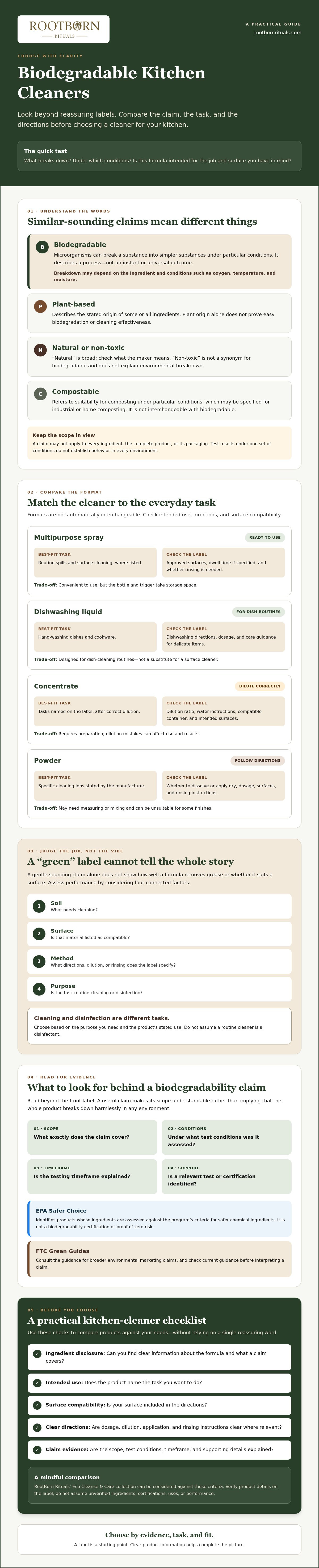
Biodegradable means that microorganisms can break a substance down into simpler substances under particular conditions. The phrase describes a process, not an instant or universal outcome. Breakdown can depend on the ingredient and the environment, including factors such as oxygen, temperature, and moisture. A result observed under one set of test conditions doesn’t establish how a product will behave in every setting.
For biodegradable kitchen cleaners, the claim alone also doesn’t tell you how well a formula removes grease, whether it’s suitable for a particular surface, or what its complete environmental impact may be. Look for precise wording and supporting evidence that explains what breaks down, how it was tested, and under which conditions. For broader context on how product choices relate to environmental quality, see Green cleaning methods and products.
Biodegradable, plant-based, and non-toxic: how the terms differ
Biodegradable refers to breakdown under specified conditions. Plant-based describes the stated origin of some or all ingredients. Plant origin doesn’t, by itself, prove that an ingredient biodegrades readily or that the finished product cleans effectively. Natural is a broad description, so check what the maker means by it. Non-toxic is not a synonym for biodegradable: it doesn’t explain environmental breakdown, and a sweeping safety claim needs clear context and substantiation.
Compostable is different, too. It refers to suitability for composting under particular conditions, which may be specified for industrial or home composting. Don’t assume compostable and biodegradable mean the same thing, or that a claim applies to every ingredient or to the product’s packaging. Broad terms without definitions, context, or evidence deserve a closer look.
What evidence can help you assess a biodegradability claim?
Read beyond the front label. Look for a clear explanation of what the claim covers, the test conditions and timeframe, and the name or details of a relevant test or certification. A credible claim should be specific enough for you to understand its scope, rather than implying that the whole product breaks down harmlessly in any environment.
The U.S. EPA Safer Choice label can help answer a different question: it identifies products whose ingredients are assessed against the program’s criteria for safer chemical ingredients. It should not be treated as a biodegradability certification or proof of zero risk. For broader environmental marketing claims, consult the FTC Green Guides and check current guidance before interpreting a claim. A thoughtful choice rests on evidence, not a single reassuring word.
Compare Biodegradable Kitchen Cleaner Types by Everyday Task
The right format depends on what needs cleaning, how you prefer to use it, and what the label says it’s made for. A counter spray, dishwashing liquid, concentrate, or powder isn’t automatically interchangeable with the others. Formulas vary, so check the intended use, directions, and surface compatibility before adding a cleaner to your kitchen routine.
| Format | Best-fit task | Label checks | Practical trade-offs |
|---|---|---|---|
| Multipurpose spray | Routine spills and surface cleaning, where listed | Approved surfaces, dwell time if specified, and whether rinsing is needed | Ready to use, but the bottle and trigger take storage space |
| Dishwashing liquid | Hand-washing dishes and cookware | Dishwashing directions, dosage, and any care guidance for delicate items | Designed for dish-cleaning routines, not a substitute for a surface cleaner |
| Concentrate | Tasks named on the label, after correct dilution | Dilution ratio, water instructions, compatible container, and intended surfaces | Requires preparation; mistakes in dilution can affect use and results |
| Powder | Specific cleaning jobs stated by the manufacturer | Whether to dissolve or apply dry, dosage, surfaces, and rinsing instructions | May need measuring or mixing, and can be unsuitable for some finishes |
Which cleaner format suits counters, dishes, and routine spills?
For a counter spill, choose a spray only if its label names that surface and type of cleaning. “Multipurpose” doesn’t mean compatible with every material. Dishwashing liquids are made for dish-cleaning routines, so follow the directions for use and rinsing instead of assuming the soap is suitable for counters. Powders and concentrates can be useful, but check whether they’re intended for the task and how they must be prepared. Specialty jobs, such as oven cleaning, may call for a product specifically labeled for that purpose.
How do concentrates and refill formats compare?
Concentrates may take less storage space for the product itself, while a refill system depends on having a compatible container and following the stated dilution. Neither format guarantees less packaging or a lower environmental impact. Compare the full instructions, including how to prepare the formula, whether a particular bottle is required, and how to dispose of or recycle packaging where accepted. For ingredient criteria, the EPA's Safer Choice program offers a useful reference, but its label isn’t a substitute for checking the cleaner’s intended task or surface guidance.
Choose for the job in front of you, not for a format’s appeal alone. As you compare biodegradable kitchen cleaners, you can also explore RootBorn Rituals' kitchen and home goods, checking the relevant product details before deciding whether an option fits your routine.
Do Biodegradable Kitchen Cleaners Work? Assess Performance and Green Claims
Biodegradable doesn’t mean ineffective, but it doesn’t guarantee a cleaner will work well, either. Performance depends on the formula, the type of soil, the surface, and how the product is used. A cleaner intended for everyday spills may not be designed for baked-on residue or a specialized job. Nor does a biodegradability claim establish that a product disinfects. Use a cleaner for disinfection only if its label and supporting evidence specifically substantiate that claim.
Formats can offer different practical advantages, but results vary by formula. Compare products designed for the same task, and treat the table as a guide to questions worth asking, not a promise of performance.
| Format | Potential advantages | Trade-offs to consider |
|---|---|---|
| Multipurpose spray | Convenient for ready-to-use cleaning on listed surfaces | May not suit every finish or stubborn residue; check whether it needs to be wiped or rinsed |
| Dishwashing liquid | Made for washing dishes and cookware by hand | Not automatically appropriate for counters or other surfaces; follow its directions for use |
| Concentrate | Can be prepared for the uses specified on the label | Requires accurate dilution and preparation; incorrect use may affect results |
| Powder | May suit particular tasks named by the manufacturer | May need measuring, dissolving, or rinsing; check compatibility with the surface |
How can you judge cleaning performance before buying?
Start with the label’s intended use, directions, and surface restrictions. Look for product-specific testing information if the manufacturer provides it, and compare like with like. A dishwashing liquid and a countertop spray serve different purposes, so their performance isn’t directly comparable. For a surface cleaner, try a small amount on a discreet area only when the directions allow it. Follow the stated method, including dilution, contact time, and rinsing instructions.
The EPA's guide to greener cleaners offers a reference for evaluating environmental attributes. Use it alongside the product’s own evidence, rather than treating one label or broad claim as proof of every benefit.
Which environmental claims need a closer look?
Separate claims about formula ingredients from statements about packaging, sourcing, or disposal. “Biodegradable” may refer to particular ingredients rather than the whole product, while “recyclable” depends on the package and what local systems accept. Ask what a broad phrase such as “environmentally friendly” specifically covers and whether the maker provides evidence for that scope.
A biodegradability claim alone doesn’t establish that a cleaner is harmless to waterways, septic systems, or ecosystems. Careful reading helps keep each claim in proportion: what the product is designed to do, what evidence supports it, and what remains unstated.
A Practical Checklist for Choosing Biodegradable Kitchen Cleaners
A considered choice begins with the task, not the label’s most appealing adjective. Use this checklist to compare biodegradable kitchen cleaners against your actual routine, then choose the smallest set of formats that covers the work you do regularly.
- Name the task. List what needs cleaning, such as hand-washed dishes, routine counter spills, or a specific appliance. An environmental claim doesn’t establish that a product is meant for every kitchen job.
- Check the intended use. Look for the product’s stated purpose and choose a formula labeled for that task. Don’t assume a dishwashing liquid is a surface cleaner, or that a multipurpose spray is appropriate for every surface.
- Read the ingredient information. Review any ingredient disclosure the manufacturer provides. If an environmental or safety statement is broad, look for an explanation of what it covers and evidence to support it.
- Confirm surface compatibility. Read cautions for materials such as stone, wood, or coated finishes. Follow any instructions for testing on a discreet area before wider use.
- Understand the directions. Check how much to use, whether a concentrate must be diluted, and whether the surface needs rinsing. Don’t combine cleaning products unless their instructions explicitly allow it.
- Assess claims and packaging separately. Check whether a certification applies to the product and the specific claim you’re evaluating. Review refill compatibility and package disposal guidance, too. A refill or recyclable-material statement alone doesn’t prove an overall environmental benefit.
What should you check on the label before purchasing?
Prioritize four essentials: ingredient information, intended use, surface cautions, and clear instructions. Then look beyond front-label terms such as “natural” or “green” for a specific explanation of the claim and its supporting evidence. If a certification is displayed, verify what it assesses rather than assuming it confirms every environmental, safety, or performance claim.
Simple routines can make these checks easier. Note your regular cleaning tasks, select only products labeled for them, and avoid adding specialized formulas unless a genuine need arises. Packaging and refills can inform your decision, but they’re separate considerations from formula ingredients and cleaning suitability.
For related ideas, explore the article on plastic-free kitchen essentials and the kitchen makeover guide. To consider products from RootBorn Rituals, explore its Eco Cleanse & Care collection and verify each relevant product’s ingredients, directions, packaging, and claims before deciding whether it fits your kitchen.
Explore RootBorn Rituals' Eco Cleanse & Care Collection Mindfully
RootBorn Rituals offers an Eco Cleanse & Care collection as part of its curated kitchen and home goods. The collection may be worth exploring as you consider a more intentional approach to household care, but the information available here doesn’t confirm individual cleaner products, ingredients, packaging, certifications, or performance. Those details matter. A collection name alone can’t show whether a particular item is among the biodegradable kitchen cleaners suited to your needs.
Let your routine guide the comparison. Identify the task you want to address, then look for a product page that clearly states the item’s purpose, directions, compatible surfaces, and ingredient information. Consider packaging separately from formula claims, and look for evidence behind any environmental language. This lets you weigh a product against the same practical criteria you’d use for other options, without assuming outcomes from broad descriptions.
How does the collection fit a more intentional kitchen?
Intentional home care is built through informed choices, not promises about what a product will do for health or the environment. RootBorn Rituals focuses on eco-friendly, plastic-free, and sustainable kitchen and home items, but those general brand priorities shouldn’t be treated as proof of a specific cleaner’s ingredients, packaging, or certifications. Review current product details before deciding how an item fits your kitchen. You can also pair cleaner research with a broader review of plastic use in the kitchen, considering where packaging choices matter in your everyday routine.
What should shoppers confirm before choosing a product?
Before selecting an item from Eco Cleanse & Care, verify that the product is currently available and relevant to the job you have in mind. Then check its intended use, ingredient disclosure, instructions, surface guidance, and packaging details. If a certification or environmental claim appears, confirm what it applies to and look for supporting information on the product page. Don’t infer a certification, cleaning capability, or biodegradability from the collection name or general brand language.
A considered choice doesn’t require a crowded cupboard. It begins with the work your kitchen actually needs, followed by clear product information that lets you judge fit with care. Explore RootBorn Rituals' Eco Cleanse & Care collection and review the available details before choosing an option for your home.
Choose Your Kitchen Care with Intention
The best choice isn’t defined by a reassuring label alone. With biodegradable kitchen cleaners, focus on the task, the product’s directions, and evidence that clarifies what a claim actually covers. Compare formats for the work you do, check surface compatibility, and consider ingredient and packaging information separately. A smaller, well-chosen set can serve your routine better than products selected on broad promises.
RootBorn Rituals offers an Eco Cleanse & Care collection within its wider range of curated kitchen and home goods, with an emphasis on eco-friendly, plastic-free, and sustainable choices. Before selecting an item, review its current product details, including intended use, ingredients, directions, packaging, and support for stated claims. Let that information guide your decision instead of assuming benefits that haven’t been verified.
Explore RootBorn Rituals' Eco Cleanse & Care collection and consider which options, if any, align with your kitchen’s needs and your values. Review the product information and choose based on the task you need to handle and the details that matter to you.
Frequently Asked Questions
What does biodegradable mean on a kitchen cleaner label?
On a kitchen cleaner label, “biodegradable” means microorganisms can break down a substance into simpler substances under particular conditions. The process depends on the substance and the environment, so a claim doesn’t mean the product breaks down equally in every setting. It also doesn’t establish cleaning performance or the product’s overall environmental impact. Read the full label and look for supporting evidence that explains what the claim covers and how it was assessed.
Are biodegradable kitchen cleaners effective?
Biodegradable kitchen cleaners can be effective, but biodegradability alone doesn’t predict cleaning results. Effectiveness depends on the formulation, the task, the surface, and whether you follow the product’s directions. A formula intended for dishwashing may not be suitable for counters, while a surface cleaner may not be designed for baked-on residue. Compare products labeled for the same job, check surface guidance, and use each according to its instructions.
Are biodegradable kitchen cleaners safe for septic systems?
A biodegradability claim alone doesn’t establish that a cleaner is suitable for a septic system. System requirements and product formulas can differ, so check the product label or manufacturer’s current guidance for septic-specific directions. Don’t assume a product is safe for your system based only on words such as “biodegradable” or “plant-based.” If the available instructions don’t answer your question, consult a qualified septic-system professional before use.
Can I use a biodegradable kitchen cleaner on every countertop?
No. Compatibility depends on the countertop material and the cleaner’s formulation, so biodegradable doesn’t mean suitable for every surface. Check both the product label and the countertop manufacturer’s care instructions before use. Some surfaces may have specific cleaning restrictions. If the product permits testing, try it first on a small, discreet area and follow the directions. Stop if you notice an unwanted change, and choose a cleaner specifically labeled for that surface.
What ingredients should I look for in biodegradable kitchen cleaners?
There isn’t one universally ideal ingredient list for every kitchen or cleaning task. Review any ingredients the manufacturer discloses, confirm the product’s intended use, and look for evidence supporting its biodegradability claim. An ingredient’s plant origin alone doesn’t prove its environmental impact or cleaning performance. If you have a specific ingredient concern, consult the product label and manufacturer’s information rather than relying on broad terms such as “natural” or “green.”
Do biodegradable kitchen cleaners disinfect?
Not necessarily. Routine cleaning removes dirt and residue, while disinfection is a separate purpose that requires a specific product claim and directions. Don’t assume a cleaner disinfects because it’s labeled biodegradable, plant-based, or multipurpose. Check the product label for an explicit disinfection claim and follow its instructions for the stated use. If the label describes cleaning only, treat the product as a cleaner, not as a disinfectant.
Are concentrated biodegradable kitchen cleaners more sustainable?
Not automatically. A concentrate may change how much product is stored or how it’s packaged, but that alone doesn’t establish a lower overall environmental impact. Check the dilution directions, whether a refill container is compatible, and how the packaging should be disposed of. Look for product-specific evidence behind any environmental claims. Compare the concentrate with alternatives intended for the same task, rather than assuming every concentrated formula is the more sustainable choice.


