


A plant-based scrubber isn’t automatically the most hygienic, durable, or lower-waste choice. The best eco friendly kitchen cleaning tools suit their tasks, are cared for properly, and have a realistic end-of-life option when they wear out.
If you’re unsure whether a brush, cloth, or sponge will hold up, or whether it can actually be composted or recycled, you’re not alone. “Natural” is a starting point, not a guarantee of performance or easy disposal.
This guide compares kitchen cleaning tools by material, everyday use, care needs, and disposal options. Use it to choose what works for dishes, surfaces, and spills without replacing everything you already own.
We’ll look at common material trade-offs, ways to care for reusable tools, and what to check before relying on compostability or recycling claims. The goal is a more considered routine, not unnecessary purchases.
Key Takeaways
- Choose eco friendly kitchen cleaning tools for the task, not for a “natural” label alone.
- Compare wood, plant fibers, cellulose, cotton, and stainless steel by their uses, care needs, and end-of-life limitations.
- Assess hygiene and durability through everyday maintenance and visible wear. Natural materials are not automatically cleaner or longer-lasting.
- Before choosing a tool, check which surfaces it can safely clean, how it should be cared for, and whether disposal claims are verifiable.
- Build a lower-waste routine gradually. Once you know what your kitchen needs, explore RootBorn Rituals’ Eco Cleanse & Care collection.
Eco-Friendly Kitchen Cleaning Tools: What Belongs in a Practical Set?
A practical set isn’t a drawer full of matching accessories. It’s a small group of tools chosen for the work they do, how they can be cleaned and maintained, how long they remain useful, and what can realistically happen to them at the end of their life. Green cleaning involves more than choosing an appealing material. Everyday use and an item’s full life matter, too.
This section focuses on reusable tools, not cleaning products. Brushes, scrubbers, cloths, and wipes lift or absorb soil. Cleaning formulas are a separate consideration, with their own ingredients and claims to assess. Keeping those questions distinct makes it easier to choose a tool without treating a “natural” label as proof of a better cleaner or a more sustainable routine.
Which cleaning tools serve everyday kitchen tasks?
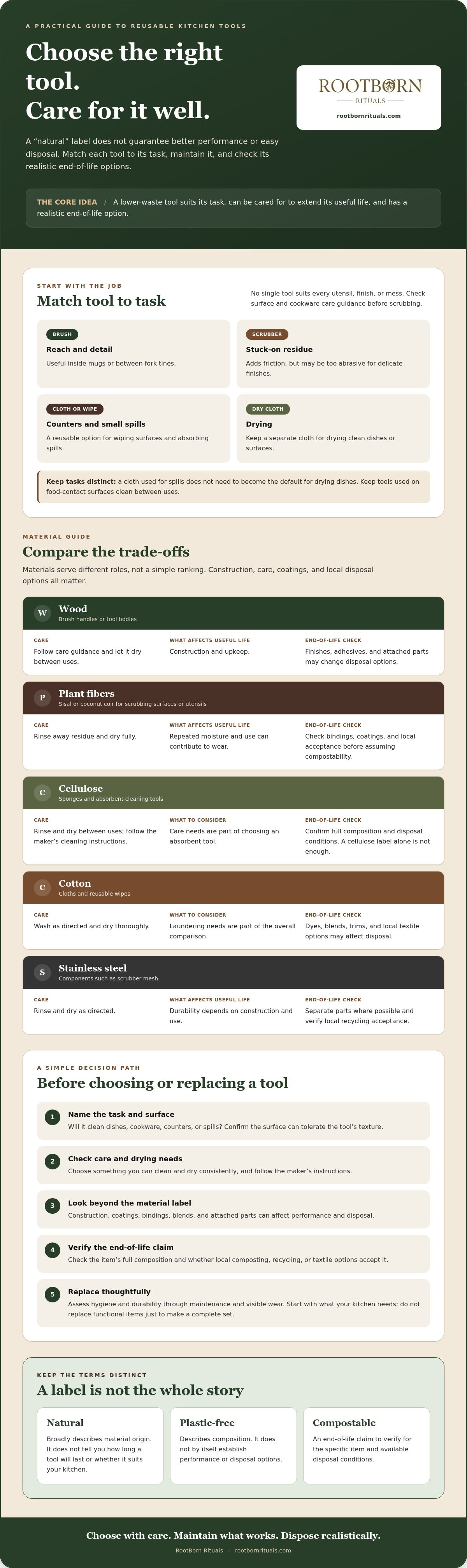
Match each tool to the task and the surface. A brush can reach inside a mug or clean between fork tines. A scrubber adds friction for stuck-on residue, but its texture may be too abrasive for delicate finishes. A cloth or reusable wipe works for counters and small spills. A separate dry cloth can absorb moisture from clean dishes or surfaces.
No single tool suits every utensil, finish, or mess. Check care guidance for cookware and counters before scrubbing, and keep tools that touch food-contact surfaces clean between uses. Separating tasks can help prevent a cloth used for spills from becoming the default for drying dishes.
What makes a cleaning tool a considered choice?
Look beyond the material name. Ask whether the tool suits the task, whether its construction can tolerate the cleaning and drying it needs, and whether you can care for it consistently. Durability matters, but so does replacement frequency: a tool that wears out quickly may need more frequent replacement, even if its material sounds appealing. At the end of its useful life, check whether its parts can be separated and whether local disposal options accept them.
“Natural,” “plastic-free,” and “compostable” describe different attributes. Natural refers broadly to material origin. Plastic-free describes composition. Compostable makes an end-of-life claim that needs to be verified for the item and the available disposal conditions. None of these terms tells you how long a tool will last or whether it suits your kitchen.
A lower-waste cleaning tool suits its task, can be cared for to extend its useful life, and has a realistic end-of-life option. That definition focuses on the tool’s whole journey, not just its first impression. Start with what your kitchen needs now instead of replacing functional items for a complete makeover.
Eco-Friendly Kitchen Cleaning Tool Materials: Weighing Everyday Trade-Offs
Material is only one part of the comparison. A tool’s useful life and disposal options can also depend on where its material came from, how it was made, whether it has a coating, and whether its components can be separated. Use the guide below as a starting point, then check the item’s care instructions and local disposal guidance.
| Material | Typical tool use | Care and durability considerations | End-of-life caveat |
|---|---|---|---|
| Wood | Brush handles or tool bodies | Follow care guidance and let it dry between uses. Construction and upkeep affect how long it remains useful. | Finishes, adhesives, and attached parts may change disposal options. |
| Plant fibers, such as sisal or coconut coir | Scrubbing surfaces or utensils | Rinse away residue and dry fully. Repeated moisture and use can contribute to wear. | Check for bindings, coatings, and local acceptance before assuming compostability. |
| Cellulose | Sponges and absorbent cleaning tools | Rinse and dry between uses, and follow the maker’s cleaning instructions. | Confirm the full composition and disposal conditions. A cellulose label alone is not enough. |
| Cotton | Cloths and reusable wipes | Wash as directed and dry thoroughly. Laundering needs are part of the overall comparison. | Dyes, blends, trims, and local textile options may affect disposal. |
| Stainless steel | Components such as scrubber mesh | Rinse and dry as directed. Durability depends on construction and use. | Separate parts where possible and verify local recycling acceptance. |
How do plant-based and reusable materials differ in use?
Cellulose can be used in absorbent tools, cotton in reusable cloths, and sisal or coconut coir in scrubbers. These materials serve different roles rather than forming a simple ranking. A cloth left damp in a heap or a brush that cannot dry between uses may need replacing sooner. For sponges and dishcloths, follow hygienic cleaning practices and the maker’s care directions.
Compostability depends on a tool’s complete construction and whether an appropriate composting facility accepts it. A tool may contain plant-based fibers as well as adhesives, coatings, or synthetic ties. Verify claims for the specific item and check local guidance before placing it in compost or recycling.
When might durable or mixed-material tools make sense?
Wooden handles and stainless steel components can be useful when they suit the task and can be maintained, but neither material alone proves a lower overall impact. Mixed-material construction can make repair, recycling, or composting harder when parts are bonded or coated. Replacement frequency matters, too. A reusable tool only offers value over repeated use if it lasts and can be cleaned as directed. A disposable option may create more frequent discards.
When comparing eco friendly kitchen cleaning tools, weigh the material against its care needs, expected useful life, and realistic disposal route. Once you know what to look for, you can browse the Eco Cleanse & Care collection and check current item details before choosing.
Are Eco-Friendly Kitchen Cleaning Tools Hygienic and Durable?
A tool made from natural materials isn’t automatically more hygienic or longer-lasting than a synthetic alternative. Cleanliness depends on how a tool is used, washed, dried, and stored. Durability depends on its construction, care, and workload. A well-maintained brush may suit one task, while a reusable cloth may be more convenient for another. Judge each tool by what it can reliably do in your kitchen, not by its material label alone.
How should reusable cleaning tools be cleaned and dried?
Start with the maker’s care instructions. A cloth, sponge, and handled brush may have different washing or drying needs, so don’t assume one sanitizing method suits them all. Rinse away visible residue after use, then let tools dry fully in an open, ventilated place rather than leaving them persistently damp in a sink or enclosed container. Keep tools for different tasks separate, and follow the cleaning product label when using a formula with them.
Cleaning a surface and disinfecting it are different tasks. A tool’s material or “eco” label doesn’t establish that it disinfects. If you’re assessing a cleaning product, the EPA guidance on greener cleaning products explains its product-focused Safer Choice and Design for the Environment programs. Use that guidance for the formula and the tool maker’s instructions for the reusable item.
When should a kitchen cleaning tool be replaced?
There’s no single replacement schedule for every material or household. Inspect tools regularly and consider replacing one if you notice:
- Fraying, cracking, loose parts, or other visible damage
- An odor that persists after appropriate washing and drying
- Worn or misshapen surfaces that no longer clean as they should
- Residue or damage that makes the tool difficult to clean properly
Use and care both affect how long an item remains serviceable. A tool used daily may show wear sooner than one used occasionally, while poor drying or unsuitable cleaning can shorten its useful life. Replace it based on condition and function, not simply because a newer material is available.
Before discarding a worn item, check what it’s made of, whether its components can be separated, and what local facilities accept. A compostable or recyclable claim doesn’t guarantee that a particular facility will take the finished tool. This helps you weigh the convenience of eco friendly kitchen cleaning tools against their real maintenance needs, without mistaking “natural” for a promise of hygiene or endurance.
How to Choose and Care for Eco-Friendly Kitchen Cleaning Tools
A measured transition starts with the tools you already use. Keep what still works, identify what causes friction in your routine, and replace items only as they wear out or no longer suit the task. This avoids a sudden pile of discards and gives you time to learn which materials and care habits fit your kitchen.
A considered sequence for choosing tools
- 1. Identify the tasks. List what you need for dishes, stubborn residue, counters, spills, and drying. Fill genuine gaps instead of duplicating items that already work.
- 2. Check the surfaces. Match brush stiffness and cloth texture to the cookware, utensils, and counters you’ll clean. Consult surface-care instructions before using an abrasive scrubber.
- 3. Compare materials. Consider how a tool feels in use and whether its construction suits the task. Treat broad labels such as “natural” or “plastic-free” as prompts to check sourcing, coatings, and component materials.
- 4. Review care and repair. Check how the tool should be washed and dried, whether its parts can be separated, and whether a worn component can be replaced without discarding the whole item.
- 5. Verify disposal. Check local recycling or composting guidance for the complete tool, not just its main material. If there’s no suitable route, account for that in your choice.
A lower-waste routine that stays manageable
Give each tool a clear role. For example, keep one cloth for counters and another for drying, and use a separate brush for dishes. After use, rinse away residue, wash items as directed, and store them where air can circulate so they can dry. A simple routine is easier to remember and helps you notice wear before a tool becomes difficult to clean or use.
Keep your set modest. A few task-specific tools are often easier to maintain than a crowded collection of near-identical items. Before buying, ask whether a new tool replaces something worn out, solves a real problem, or merely adds another care requirement. That pause can prevent redundant purchases while helping you build a routine gradually.
For a step-by-step approach to reducing plastic in your kitchen, explore the plastic-free kitchen transition guide. You can also consider how cleaning choices fit into other changes to your kitchen. When you’re ready to compare relevant options, browse RootBorn Rituals’ Eco Cleanse & Care collection and check current item details against your needs.
A More Intentional Kitchen Cleaning Routine with RootBorn Rituals
A considered routine doesn’t require replacing every brush, cloth, or sponge at once. Choose a tool for a specific task, care for it according to its instructions, and check what can realistically happen to it when it wears out. Keeping useful tools in service and replacing only what’s needed makes a lower-waste shift more practical.
What should you verify in a product description?
Look past broad terms such as “natural,” “green,” or “compostable.” Check the details available for the complete item, including its handle, bristles, bindings, coatings, and joined components. Clear care instructions explain how to clean and dry a tool. Specific environmental claims should be supported by product information, not just a label.
Give disposal the same attention. Confirm whether guidance applies to the entire tool or only one material, then compare it with what local recycling or composting facilities accept. If the information isn’t clear, don’t assume the item belongs in a particular waste stream.
How can the Eco Cleanse & Care collection fit your needs?
RootBorn Rituals’ Eco Cleanse & Care collection is a place to explore relevant options, but the collection name alone doesn’t establish an item’s materials, care needs, certifications, or performance. Review current product descriptions and compare the details with your needs: the task, the surface, the maintenance you can manage, and the item’s realistic end-of-life route.
For eco friendly kitchen cleaning tools, a thoughtful choice fits your routine rather than adding another unused object. Keep what works, replace what no longer serves its purpose, and let each new tool earn its place through clear, relevant information.
When you’re ready to explore, visit the RootBorn Rituals online store and review the details of any option you’re considering.
Make Your Next Kitchen Choice with Intention
A more thoughtful cleaning routine doesn’t begin with a complete replacement. It begins by choosing a tool for a specific task, caring for it so it remains useful, and checking whether its materials have a realistic end-of-life option. These details matter more than a “natural” or “compostable” label alone.
The best eco friendly kitchen cleaning tools suit your surfaces and daily habits, can be maintained with care, and don’t create unnecessary clutter. Keep functional items in use and replace them gradually when they’re worn or no longer serving their purpose.
RootBorn Rituals offers an Eco Cleanse & Care collection. Its current contents may change, so review product descriptions for material, care, and disposal details before deciding what fits your kitchen.
Small, considered choices can make everyday care feel simpler and more aligned with your values. Begin with what you need, then explore the RootBorn Rituals online store.
Frequently Asked Questions
What are the most useful eco-friendly kitchen cleaning tools to start with?
Start with a dish brush, a scrubber suited to your cookware, and reusable cloths for wiping and drying. Choose each for a specific task and surface rather than buying a large set. Check care instructions before choosing, especially if a tool needs particular washing or drying conditions. A small, well-used selection of eco friendly kitchen cleaning tools can be more practical than several items that duplicate jobs.
Are natural kitchen cleaning tools more hygienic than plastic ones?
No material is automatically more hygienic. Hygiene depends on how a tool is used, cleaned, dried, and stored, not just whether it’s natural or plastic. Rinse away residue, follow the maker’s cleaning instructions, and let reusable tools dry between uses. Keep tools for different tasks separate where practical. Replace an item if persistent odor, damage, or residue makes it difficult to clean or less effective.
Can wooden dish brushes or plant-fiber scrubbers be composted?
Sometimes, but don’t assume the whole tool is compostable because its handle or bristles are made from wood or plant fibers. Bindings, adhesives, coatings, and other components can affect disposal. Check the product’s material details and confirm that local composting facilities accept the complete item. If parts can be separated, verify each part’s disposal route and follow local guidance rather than relying on a broad label alone.
How often should reusable kitchen cleaning tools be replaced?
There isn’t one replacement schedule for every tool. Frequency of use, material, and care all affect how long an item stays useful. Inspect it for fraying, cracking, loose parts, persistent odor, or reduced cleaning performance. Wash and dry it as directed, then replace it when wear prevents proper cleaning or function. Before disposal, check whether local facilities accept its materials, especially if the tool combines several components.
Are biodegradable kitchen cleaning tools always better for the environment?
No. “Biodegradable” alone doesn’t tell you how long a tool lasts, what conditions are needed for breakdown, or whether local facilities can process it. Construction matters, too: coatings, adhesives, and mixed materials may affect disposal. Compare the complete item’s materials, care needs, useful life, and realistic end-of-life route. A tool that suits its task and remains useful with proper care may be a more considered choice than a label alone suggests.
How can I reduce plastic in my kitchen cleaning routine without replacing everything?
Keep functional tools in use and replace them gradually as they wear out or stop serving their purpose. Before buying a replacement, identify the task, check the surface it will clean, and review material and care information. Choose a tool that fills a real need instead of adding a duplicate. This measured approach avoids unnecessary discards and gives you time to learn which options fit your routine and disposal choices.


