


What if the very vessels meant to shield your nourishment are actually compromising its purity? It's a question many of us face as we stand before pantries filled with uninspiring plastic that leaches chemicals and sheds microplastics into our daily meals. You deserve a kitchen that feels like a sanctuary rather than a source of anxiety. By returning to ancestral materials, you can transform your home into a space of intentional wellness. Our guide to natural preservation essentials offers a clear path toward a non-toxic, beautifully organized environment where every object serves a purpose and honors the earth.
You've likely felt the desire to align your storage habits with your eco-conscious values but felt overwhelmed by the technicalities of glass types or the safety of ceramic glazes. We understand that this transition requires both wisdom and discernment. This guide provides the clarity you need to choose materials that truly work for your lifestyle. We'll examine the specific benefits of unglazed clay, the antimicrobial properties of sustainable hardwoods, and the thermal shock resistance of borosilicate glass. By the end, you'll have the confidence to curate a pantry that preserves the life of your food and the health of your home.
Key Takeaways
- Understand how returning to ancestral materials protects your food's vitality from the silent intrusion of microplastics and chemical leaching.
- Discover why unglazed clay serves as the gold standard for purity and how to select the right material for every preservation ritual in your kitchen.
- Learn to curate a sanctuary of health by integrating natural preservation essentials that balance modern sophistication with timeless, handcrafted functionality.
- Identify the specific features of high-quality fermentation vessels and proofing tools to ensure the longevity and safety of your artisanal creations.
- Master the simple yet essential care rituals needed to maintain porous natural materials without the use of toxic synthetic soaps.
The Philosophy of Purity: Why Natural Preservation Essentials Matter
Preservation is not merely a utility. It is an intentional return to material purity and ancestral wisdom. When we choose to steward our food rather than simply store it, we honor the vitality of the ingredients we've gathered. This shift in perspective transforms the kitchen from a place of convenience into a sanctuary of wellness. By integrating natural preservation essentials, you create an environment that supports both physical health and spiritual peace. True stewardship recognizes that the quality of the vessel is as important as the quality of the harvest.
The tools we choose are the guardians of our nourishment. A pantry curated with intention becomes more than a storage space; it becomes a library of wellness. Every jar and crock serves as a testament to a lifestyle that rejects the frantic pace of modern consumption in favor of a slower, more deliberate rhythm. This philosophy treats the home environment with gravity, acknowledging that the objects we interact with daily have a profound impact on our internal landscape.
The Hidden Dangers of Conventional Storage
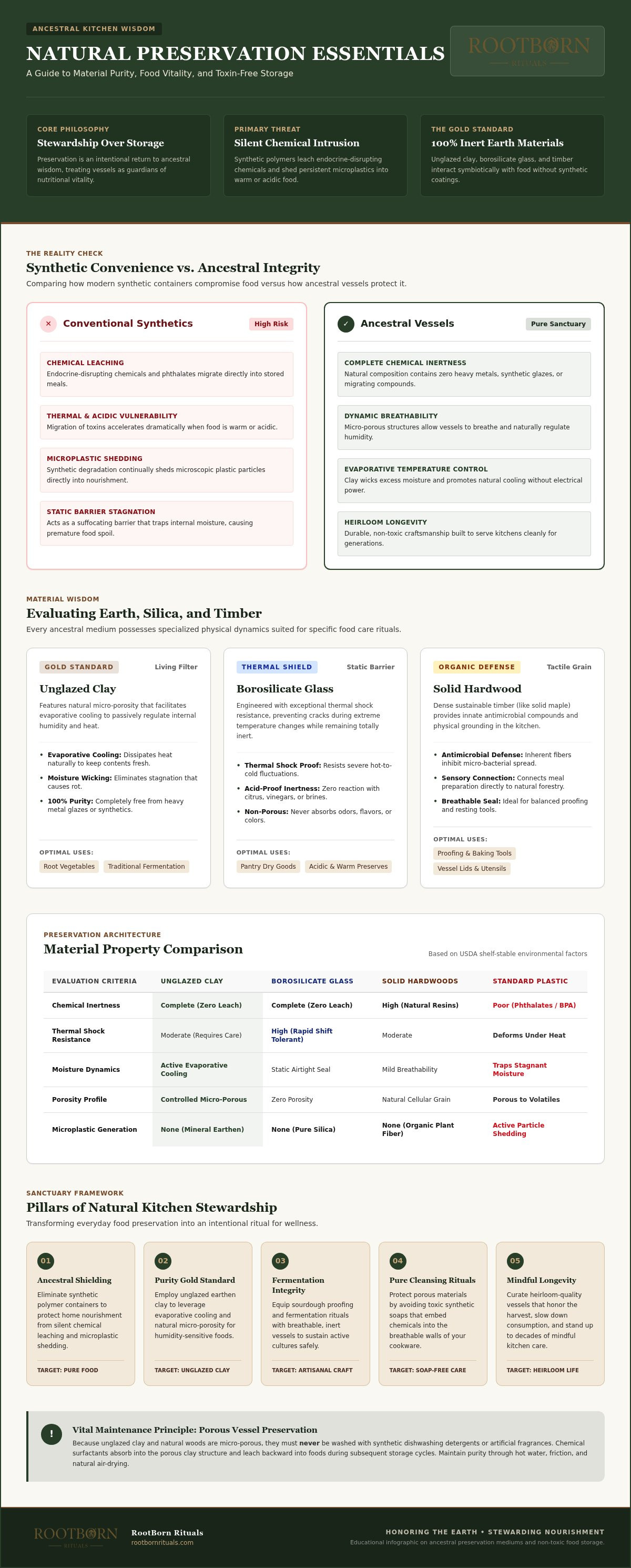
Conventional storage often relies on synthetic polymers that compromise the very nourishment they're meant to protect. Endocrine-disrupting chemicals and phthalates can migrate from plastic containers into your meals, a process that accelerates when food is acidic or warm. Recent awareness regarding microplastic shedding has led many to reconsider their relationship with disposable culture. Learning how to remove plastic from your kitchen is a vital step toward reclaiming the sanctity of your home. It’s about more than organization; it's about protecting your body from the silent intrusion of chemical leaching.
Embracing Ancestral Wisdom in the Modern Kitchen
Ancestral materials like unglazed clay, solid wood, and borosilicate glass offer a level of inertness that modern synthetics cannot replicate. These materials don't just protect; they breathe and interact with food in ways that enhance its longevity. Utilizing traditional food preservation techniques allows us to step away from the fragility of a disposable lifestyle. Interacting with the weight of a ceramic crock or the grain of a maple lid provides a sensory connection to the natural world. This transition is the foundation of a non-toxic kitchen makeover that values quality over convenience and health over haste. By choosing heirloom-quality vessels, you ensure that your kitchen remains a place of purity for generations.
Material Wisdom: Comparing Clay, Glass, and Wood for Food Care
Selecting the right vessels for your kitchen is a ritual of discernment. Unlike synthetic alternatives that act as static barriers, natural materials interact with their contents in a symbiotic dance. To achieve a truly non-toxic pantry, we must evaluate our tools based on their porosity, thermal stability, and chemical inertness. These factors determine how well a material can protect food vitality while adhering to USDA shelf-stable food storage guidelines regarding environmental control. By understanding the inherent wisdom of earth, silica, and timber, you can curate a collection of natural preservation essentials that serve both health and harmony.
Unglazed Clay: The Breathable Guardian
Unglazed clay remains the pinnacle of food care due to its unique micro-porosity. This characteristic allows for evaporative cooling, a process that naturally regulates internal temperatures and humidity. It's particularly effective for storing root vegetables and facilitating traditional fermentation rituals. Clay vessels act as living filters, wicking away excess moisture while preventing the stagnation common in plastic tubs. We consider this material the gold standard of unglazed clay because it remains entirely inert, ensuring no heavy metals or synthetic coatings touch your nourishment. For those seeking the highest level of purity, exploring a curated natural preservation collection is the first step toward a mindful kitchen.
Glass and Wood: The Harmony of Visibility and Protection
Glass offers unparalleled clarity and inertness. High-borosilicate glass is especially valued for its thermal resistance, capable of withstanding sudden temperature shifts of 150°C without fracturing. This makes it superior to common soda-lime glass for hot fills or freezer transitions. When paired with close-grained hardwood lids, such as hard maple or walnut, glass jars provide a sanctuary for dry goods. These woods are favored under FDA guidelines for their natural antimicrobial properties and tight grain structures that resist bacterial harbor. The tannins in these hardwoods work silently to maintain a clean environment, while the breathable seal prevents the sweating that often leads to premature spoilage in airtight plastic.
To organize your sanctuary effectively, consider matching the material to the specific needs of the ingredient:
- Unglazed Clay: Ideal for garlic, potatoes, and active ferments that require humidity regulation.
- Borosilicate Glass: Best for grains, legumes, and liquids where visual inventory is essential.
- Hardwood: Perfect for bread storage and dry vegetable bins that benefit from natural air circulation.
Choosing Your Essentials: A Guide to Preservation Rituals
Curating your kitchen is an act of mindfulness. It requires a transition from the chaotic, mismatched containers of the past to a refined selection of natural preservation essentials. When we approach food storage as a series of rituals, such as fermenting, proofing, and storing, we begin to see the profound impact that the right vessel has on the vitality of our nourishment. Following FDA safe food storage recommendations ensures that your aesthetic choices are grounded in safety, but the beauty of natural materials offers a layer of sanctity that industrial standards often overlook.
The Fermentation Ritual: Selecting the Right Crock
Fermentation is a living process that demands a stable environment. When selecting a crock, consider the weight and thermal mass of the material. Heavy-weight unglazed clay or vitrified stoneware provides the temperature stability necessary for consistent microbial activity. Water-seal crocks are particularly effective for beginners. They create an anaerobic environment that allows carbon dioxide to escape while preventing oxygen and dust from entering. Traditional open-top vessels offer a more hands-on connection to the process, though they require careful weighting of the ingredients. For a typical household, a three to five liter crock is often the ideal size for weekly batches of probiotic rich vegetables.
Pantry Curation: Organizing for Longevity
The sanctuary of your pantry relies on the harmony between visibility and protection. Choosing the right volume for your jars is essential to minimize oxygen exposure. When a jar is too large for its contents, the excess headspace accelerates the oxidation of delicate oils in nuts and seeds. High-quality borosilicate glass paired with close-grained hardwood lids creates an airtight yet breathable seal. This combination is a cornerstone of plastic-free kitchen essentials, ensuring that no synthetic polymers touch your dry goods.
Evaluating your pantry tools requires a discerning eye for detail. Use this checklist to ensure your vessels meet the highest standards of purity:
- Seal Integrity: Ensure lids use natural silicone or precision-fit wood rather than plastic liners.
- Material Density: Choose thick-walled glass or clay to protect against light and temperature fluctuations.
- Labeling Ritual: Avoid adhesive plastic labels. Use stone tags, ceramic markers, or simple twine to identify your stores.
- Breathability: For items like bread or onions, prioritize perforated clay or rattan baskets that prevent moisture buildup.
By selecting tools that respect the biological needs of your food, you transform storage into stewardship. The result is a pantry that is not only beautiful and organized but also a true sanctuary of health.
Avoiding Common Mistakes in Natural Food Storage
Transitioning to a kitchen defined by purity requires more than just new vessels; it demands a shift in how we interact with our tools. Many people hesitate to adopt natural preservation essentials because they fear the maintenance is too demanding. This is a misconception born from a culture of disposability. In reality, caring for ancestral materials is a simple, rhythmic act that ensures your sanctuary remains healthy and your food remains untainted. One of the most common errors is choosing look-alike plastics, items that mimic the aesthetic of stone or wood but are actually synthetic resins. These materials still leach chemicals and lack the breathable wisdom of true earth and timber.
The Myth of Fragility
While a plastic tub might survive a drop, its functional lifespan is remarkably short, often ending in a landfill within a year or two due to staining and odor retention. A high-quality clay crock or hardwood bin, however, can serve your family for generations. These tools don't just last; they evolve with use. Curing is a sacred ritual of preparing a vessel's surface to enhance its inherent durability and resistance to moisture. By properly seasoning your wooden boards with food-grade oils or soaking your clay vessels before their first use, you build a foundation of longevity that no synthetic alternative can match.
Cleaning and Care Rituals
The most significant danger to porous materials like unglazed clay and wood is the use of synthetic dish soaps. These vessels act like sponges, absorbing the artificial fragrances and surfactants found in conventional cleansers. When you later store your food, those chemicals can migrate into your nourishment. Instead, lean into the simplicity of hot water and baking soda for a deep, non-toxic clean. This method respects the material's integrity while ensuring a high standard of hygiene.
Proper drying is equally vital. Natural materials need to breathe. Storing a damp clay pot in a dark cupboard is an invitation for mold, a mistake that is easily avoided by allowing your essentials to air-dry completely. Whenever possible, let your tools rest in direct sunlight; the ultraviolet rays act as a natural, gentle sterilizer that refreshes the material. Never subject these items to the violent heat and harsh detergents of a dishwasher, as this will strip the natural oils from wood and cause clay to become brittle. To begin your transition with confidence, explore our curated Natural Preservation Essentials to find tools designed for a lifetime of purity.
Curating Your Sanctuary: The Natural Preservation Essentials Collection
Building a kitchen sanctuary requires a shift from the utilitarian to the ritualistic. Every object you place on your shelf should tell a story of material purity and ethical stewardship. The RootBorn Rituals collection serves as a physical manifestation of this philosophy, bridging the gap between ancient wisdom and the sophisticated needs of a modern home. These aren't just containers. They're functional art pieces designed to honor the life within your food while protecting your family from the silent intrusion of synthetic polymers. By treating your pantry with gravity, you ensure that every choice aligns with a deeper connection to the natural world.
Our curated selection of natural preservation essentials is organized into six distinct categories, each vetted for its impact on holistic health and environmental integrity. These include unglazed clay fermentation crocks, borosilicate glass jars with sustainable hardwood lids, artisanal bread proofing baskets, breathable ceramic produce keepers, natural fiber storage bags, and heritage cellaring vessels. By choosing these tools, you're investing in a legacy of wellness that rejects the ephemeral nature of plastic in favor of materials that endure. Each piece is handcrafted with intention, ensuring that your kitchen remains a sanctuary of ancestral purity for years to come.
Featured Essentials for the Mindful Kitchen
Within this collection, the unglazed clay fermentation vessels stand as the gold standard for probiotic health. Their micro-porous walls allow your ferments to breathe, regulating temperature with a precision that synthetic crocks can't match. For the pantry, our glass and wood storage jars provide a clear, non-toxic library of nourishment. They allow you to inventory your grains and seeds without exposing them to the risks of chemical leaching discussed earlier. The artisanal bread proofing baskets offer the home baker a traditional way to shape their loaves, utilizing natural rattan to manage moisture and ensure a perfect crust. These tools transform the act of food preparation into a sacred ceremony.
Begin Your Preservation Journey
A complete kitchen makeover can feel daunting, so we encourage you to start with intention. Begin your journey by selecting one or two high-impact pieces that align with your daily rituals, perhaps a fermentation crock for your weekly kraut or a set of glass jars for your most-used grains. Each addition to your pantry is a step toward a more intentional, non-toxic lifestyle. We invite you to explore the full Natural Preservation Essentials collection to discover vessels that resonate with your values. Our commitment to ancestral purity ensures that every piece you bring into your home is a guardian of your health and a tribute to the natural world.
Cultivating a Legacy of Kitchen Purity
Choosing a kitchen free from synthetic intrusion is a profound act of stewardship. By transitioning to vessels rooted in ancestral wisdom, you protect the vitality of your nourishment and the sanctity of your home environment. You now understand that materials like unglazed clay and borosilicate glass are not merely storage options; they are the guardians of your health. Through intentional care rituals and a discerning eye for material purity, you can eliminate the risks of microplastics and chemical leaching forever.
Our collection is handcrafted from unglazed, organic clay and 100% plastic-free materials, ensuring that every piece serves both ancestral function and modern aesthetics. This is your invitation to move beyond the disposable and invest in tools that endure for generations. Elevate your kitchen with our Natural Preservation Essentials collection and begin your journey toward a truly non-toxic sanctuary. Your path to a more intentional way of living starts with the very objects you touch every day. We invite you to slow down and honor the profound impact of these simple, sacred choices.
Frequently Asked Questions
What are the most important natural preservation essentials for a beginner?
The most important natural preservation essentials for a beginner include high-borosilicate glass jars for dry goods and a single unglazed clay fermentation crock. These two categories address the primary needs of pantry organization and probiotic health. You might also consider adding breathable linen produce bags to replace plastic wraps. By focusing on these foundational pieces, you create an immediate impact on your kitchen's purity while learning the rhythmic care these ancestral materials require daily.
Is glass truly better than plastic for long-term food storage?
Glass is superior because it is non-porous and chemically inert. Unlike plastic, it doesn't leach endocrine disruptors or absorb food odors and stains over time. High-borosilicate glass offers exceptional thermal shock resistance, making it safer for sudden temperature changes. It provides a permanent, non-toxic barrier that maintains the purity of your ingredients for years. Plastic eventually degrades and sheds microplastics into your nourishment, compromising its vitality and your long-term wellness.
How do I clean unglazed clay preservation crocks without soap?
Use a mixture of hot water and baking soda to scrub your clay vessels effectively. Because unglazed clay is porous, synthetic soaps will be absorbed into the material and later leach into your food. A gentle paste of baking soda acts as a mild abrasive to remove residue without compromising purity. Always allow the crock to air-dry completely in a well-ventilated area, preferably in direct sunlight, to ensure natural sterilization and prevent moisture retention.
Can natural wood lids provide an airtight seal for pantry goods?
Precision-fit wood lids often utilize a natural silicone gasket to achieve a reliable, airtight seal. While wood itself possesses a natural breathability, these gaskets prevent the oxygen ingress that causes oxidation in delicate dry goods. Close-grained hardwoods like maple or walnut are preferred for their stability and natural antimicrobial properties. This combination ensures your natural preservation essentials remain highly functional while allowing the grounding aesthetics of the natural world to grace your pantry shelves.
What is the best material for fermenting vegetables at home?
Unglazed clay is the gold standard for home fermentation. Its micro-porous structure regulates temperature and allows for subtle gas exchange, creating the ideal environment for beneficial microbes to thrive. Unlike glass, clay protects light-sensitive nutrients from degradation during the long fermentation process. It provides the thermal mass needed to keep cultures stable, resulting in a more consistent and flavorful probiotic harvest that honors traditional ancestral methods and ensures material purity.
Do natural materials actually help food stay fresh longer than plastic?
Natural materials regulate humidity and temperature in ways that synthetic plastic simply cannot replicate. For example, unglazed clay keepers prevent the moisture buildup that leads to premature rot in garlic and potatoes. Breathable wood and linen allow for gentle air circulation, which stops artisanal bread from becoming moldy due to trapped condensation. Plastic creates a stagnant, airtight environment that often accelerates spoilage. By choosing materials that respect biological needs, you extend food vitality naturally.
Are these preservation tools safe for storing acidic foods like ferments?
Lab-certified, lead-free ceramics and borosilicate glass are perfectly safe for acidic contents. You must avoid unverified glazed earthenware, as the acid in ferments can leach heavy metals from low-quality glazes. RootBorn Rituals prioritizes unglazed, organic clay and inert glass to ensure total purity. These materials won't react with the low pH of vinegar-based pickles or lactic acid ferments, keeping your food safe and its flavor profiles untainted by metallic or chemical notes.
How do I avoid mold growth in wooden or clay storage vessels?
Proper drying is the most effective way to prevent mold growth in natural vessels. Never store a damp pot in a closed cupboard, as moisture trapped in the pores of wood or clay will encourage fungus. After cleaning with hot water, let your tools dry in an open, airy space. Occasional exposure to sunlight provides a natural ultraviolet treatment that refreshes the material. Ensuring your storage area is cool and dry further protects your investment.


